Frederick Woodruff introduces “I Love You Jeffrey Dahmer”
Frederick Woodruff’s I Love You Jeffrey Dahmer begins with a deliberately uncomfortable proposition: what happens when desire survives knowledge? Part supernatural romance, part alternative history, the novel places a fictional gay man inside the already mythologised story of Jeffrey Dahmer, allowing attraction, obsession and the possibility of changing history to collide with everything the reader already knows.
Rather than retelling the familiar chronology of the crimes, Woodruff uses fiction to enter more unstable territory—projection, erotic fixation, psychological intimacy and the strange cultural machinery that can turn a murderer into an icon. In this conversation, he discusses writing explicit sexuality without softening its contradictions, drawing on psychological records and astrology, imagining a different fate for Dahmer’s victims, and why fiction offered a way into questions that conventional true crime could not.
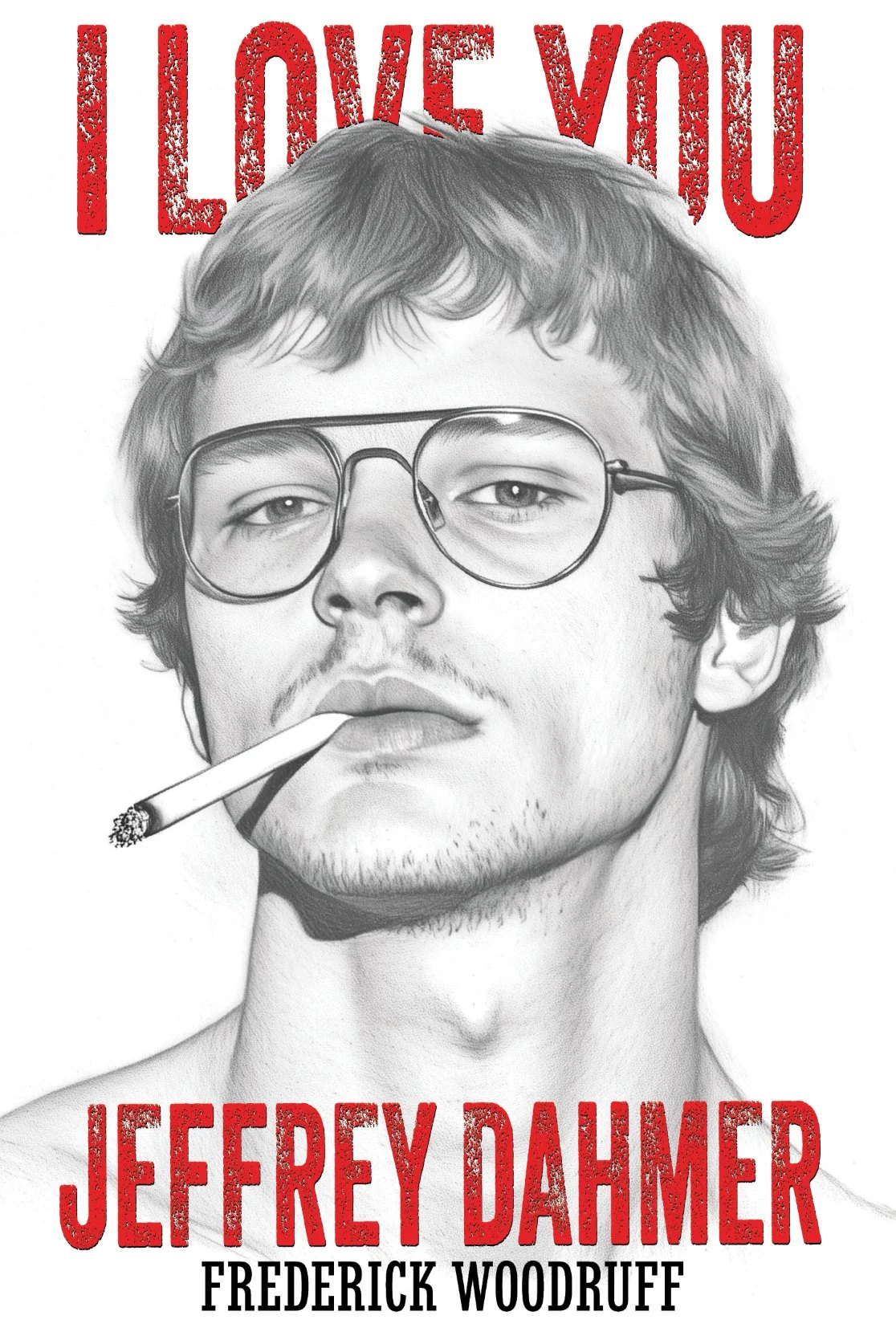
Love You Jeffrey Dahmer is a fictional novel about a man who becomes sexually and emotionally obsessed with Jeffrey Dahmer, and eventually history itself begins to shift around them. What came first for you? The love story, the fascination with Dahmer, or the idea of changing his fate?
Fascination, definitely. As an astrologer, Dahmer’s horoscope had intrigued me from the start—when he first appeared on the cultural radar back in the 90s. Jeff’s chart has key markers that, in traditional astrology, indicate accomplishment and good fortune. Although no one ever considered that all of that luck would play out as his incredible run of luck during his killing spree.
My intrigue doubled after watching Ryan Murphy’s series on Netflix. After the show ended, I asked myself, “What would it be like to be Jeff’s lover?” As a gay man, on a purely physical level, I found Dahmer extremely attractive. A 6-foot guy, in great physical shape, with blue eyes and a mane of Robert Redford-like blond hair.
You describe the book as a “taboo serial-killer romance, based on true crime.” What could you explore through fiction that you could never have explored in a conventional true-crime book?
There are scores of books written that track the factual data of Dahmer’s life. That approach had no allure for me. But as a fiction writer, I wanted to allow my unconscious to uncover insights into Dahmer’s psychology. When you write a first-person book, you can’t help but conjure a ‘relationship’ with your character. A connection that exists in a liminal realm of unexpected plot possibilities. And so a supernatural romance novel was the way to go. I wrote the book in longhand on large pink Mead Cambridge writing pads, and the first line that landed on the paper was “The longhaired boy came to me again last night.” That instantly set the tenor of the book on its way.
Jeffrey Dahmer has been represented so many times that there is almost a cultural version of him separate from the real person. When writing your Jeffrey, how did you decide what belonged to the historical man and what belonged to your fictional world?
Right, right that was a strange alchemy. Mention Jeff’s name, and all the cliches start popping. When I interviewed the woman who worked with Patrick Kennedy, the detective who interrogated Dahmer, she told me that when people are asked to list the three most evil people in the world, they mention Hitler, Stalin, and Jeffrey Dahmer.
Your question is great because it made me rethink my trajectory moving from fact into fiction. I already knew all the particulars from all the Dahmer bios—especially the intimate revelations from Jeff’s dad, Lionel.
But it was the psychological reports I purchased from the courts—the interviews and notes compiled by the shrinks hired by the prosecutors and defense attorneys—that gave me the most substance to work with. Jeff was his most candid and forthcoming in those exchanges.
Once the book took off organically, I relied on the projections and transferences—between David, the book’s protagonist, and Jeff—as a way to give validity to the fictional parts. I’ve always considered that psychological defense mechanisms are how we learn the most about ourselves and how our central relationships influence our destiny.
In the book, David knows things about Jeffrey that should make attraction impossible, and yet the attraction intensifies. What interested you about putting desire and knowledge into direct conflict with one another?
Well, I’ve had experiences with extreme romantic irrationality. When I was younger, I had several codependent relationships with complicated men—compulsive liars, thieves, alcoholics, and drug addicts. When friends (and the various counselors I worked with) asked me, “Why do you continue to stay with this person?” the answer was always the same: he was beautiful, and the sex was otherworldly. My horoscope is dominated by the Moon and Saturn in Scorpio. And my Venus is in Gemini, and Jeff was the quintessential trickster Gemini. That’s astrological shorthand for answering your question, too.

The title I Love You Jeffrey Dahmeris incredibly confrontational—it almost forces a reaction before somebody has read a single page. Why did you want to call the book that?
It was an obvious choice, and it came to me before composing the book. It telegraphed quickly the essence of the manuscript and David’s (and the reader’s) emotional quandary.
One of the difficult things about this premise is making Jeffrey sexually and romantically magnetic without asking the reader to forget what he did. How did you approach that tension while writing him?
Well, it’s important to remember popular culture’s unwavering fixation on true crime. Especially the way it transforms serial killers into icons or anti-heroes. A lot of this has to do with the complex shadow nature of America, a country with such a twisted puritanical origin. So while the book’s theme might make people groan, nearly everyone has a secret part that revels in the twisted side of sex and crime.
After his apprehension in 1991, when Dahmer first appeared in court, all of Milwaukee became transfixed. The public expected a ghoul to appear in the courtroom on that first day, but then in walked this handsome blond white guy. One reporter described him as “…looking like a Kennedy.” The media began treating the court dates like Hollywood movie premieres. Women scrambled to get a seat close to the defense attorney’s side of the room, and cops would approach Dahmer in the holding room for his autograph.
The book carries a warning: “Extreme sexual content.” What does explicit sex allow you to reveal about David, Jeffrey and their relationship that you couldn’t have communicated by keeping the sex off the page?
Well, that was a crazy warning required by Amazon about the book, but Jesus, people should read some Dennis Cooper’s novels for a truly shocking conflation of homoerotics and criminality.
I needed the seductive aspect of the narrative to be the book’s baseline—the glue that linked the men. So it was important to be graphic with the sex scenes. And the explicit parts were the hardest to write. Sex in fiction is so often handled badly—glossed over, treated as a narrative afterthought. I think it’s actually where people are rawest, most human. So I refused to pull punches. To avoid cliches and corniness in creating erotic scenes is tough.
You’ve had a rather unusual creative path yourself—journalism, astrology, erotic writing, and your work with the Bob Mizer Foundation. Do those worlds feed into the way you write about masculinity, sexuality, and obsession?
Yes, I believe so. The Mizer Museum celebrates nude male beauty in all its various facets. And working as their art director requires that my visual skills be fine-tuned within that arena. And it is that visual part of my nature that responded to the work of the artist Volk Kinetshniy who created the illustration of Jeff for my book. I discovered their work several years into my writing process (you can read our discussions here). Volk’s illustrations offered my imagination a pristine version of Jeff to consider.
For someone looking at that cover and thinking, “There is absolutely no way I’m going to read a Jeffrey Dahmer romance”—what would you tell them they’re actually going to find inside the book?
The book is exactly not what they’re assuming. It’s something more confounding. This is a supernatural, alternative history of the Dahmer story. This was a style I chose, as I had a compulsion as a fiction writer to ‘save’ the 16 boys who eventually became ‘just numbers’ in the true crime annals associated with Jeff.
I built an overly romantic atmosphere for the book as well, putting readers in a predicament by conjuring feelings anyone who’s been deeply in love would recognize. When David first meets Jeff and is swallowed up in the scent of cocoa (because Dahmer has just come to the bar after working his shift at the chocolate factory), you get instantly why a gay man would be smitten by the tall, mysterious beauty. And so begins the reader’s odyssey.