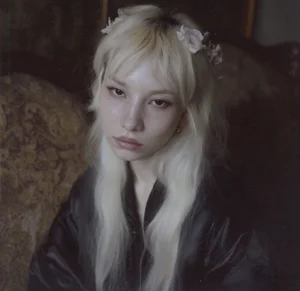
Giusy Amoroso Is Growing New Forms of Life
Giusy Amoroso’s creatures do not arrive from another world. They appear to have survived this one by absorbing it: metal into skin, contamination into anatomy, technology into flesh. Moving between digital modelling and physical fabrication, the Berlin-based artist creates organisms caught mid-adaptation. Organisms that are seductive, unsettling and never entirely separate from the conditions that produced them. In her work, identity is not a stable outline but an accumulation of every pressure, material and environment a body has moved through.
We spoke to Amoroso about finding beauty beyond cultural conditioning, uncertainty as a creative force, biology’s influence on her practice and the persistence of the human beneath even the most radical transformation. For her, mutation is not the destruction of form, but the process through which something becomes what it was capable of being all along.
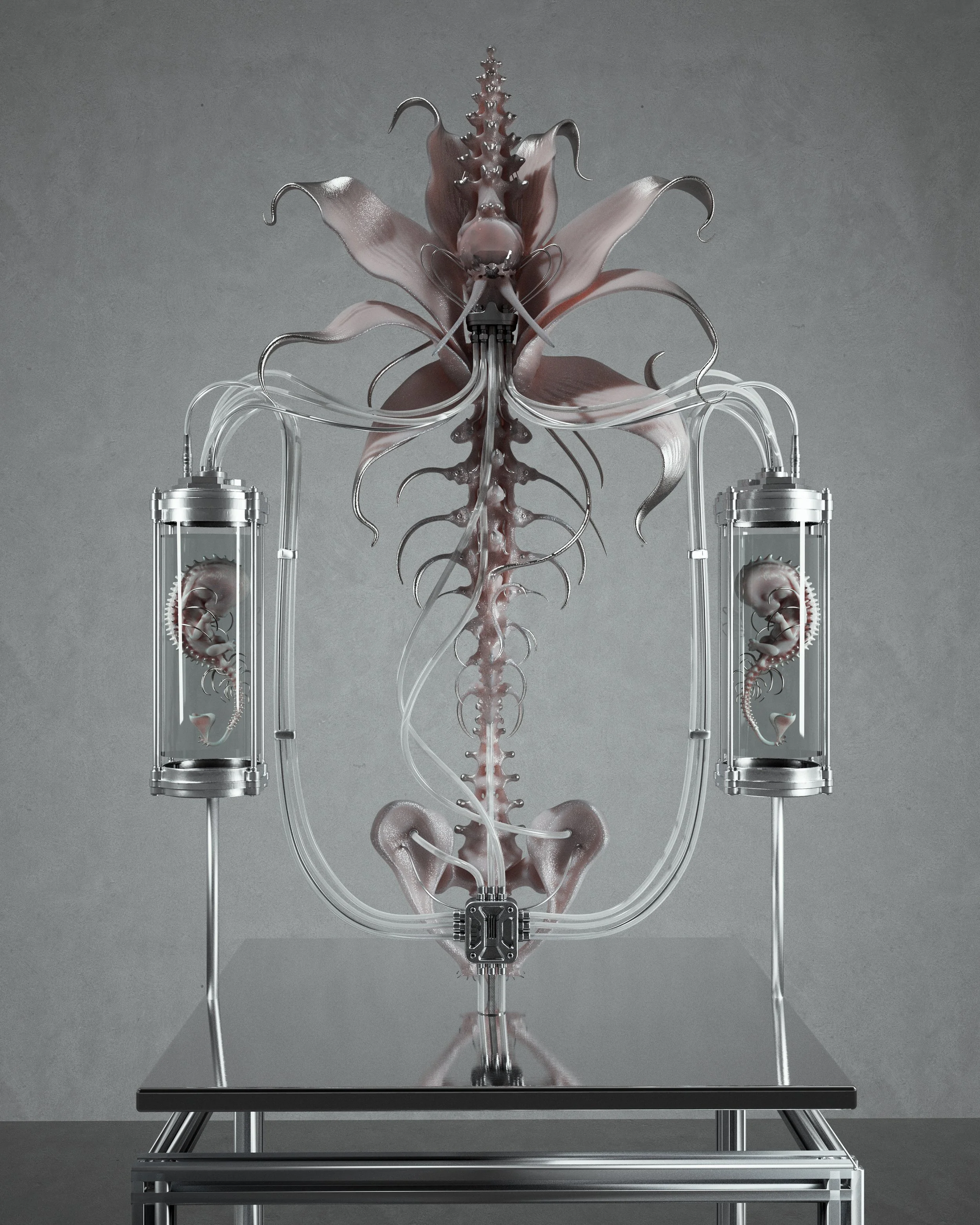
Apparatus ID - ME-01, 2026
Your work rarely asks the viewer to imagine another world, it asks us to see this one differently. Do you think artists have a responsibility to expand perception? How do you wanna do that?
I wouldn't frame it as a responsibility exactly, because that implies a kind of obligation that can make art feel heavy-handed. But I do think art is one of the most effective tools we have for shifting perception, and that's one of the things I'm trying to do with my work.
One idea I often return to, and that I also explored in my latest TEDx talk, is that beauty can exist in forms we instinctively reject or find uncomfortable. That isn't an abstract principle for me. It shapes how I build these organisms. I want someone standing in front of them to feel drawn toward something that also unsettles them, and to remain with that contradiction long enough for the way they look to begin to change.
I'm not trying to show people another world but to make this one harder to look away from.
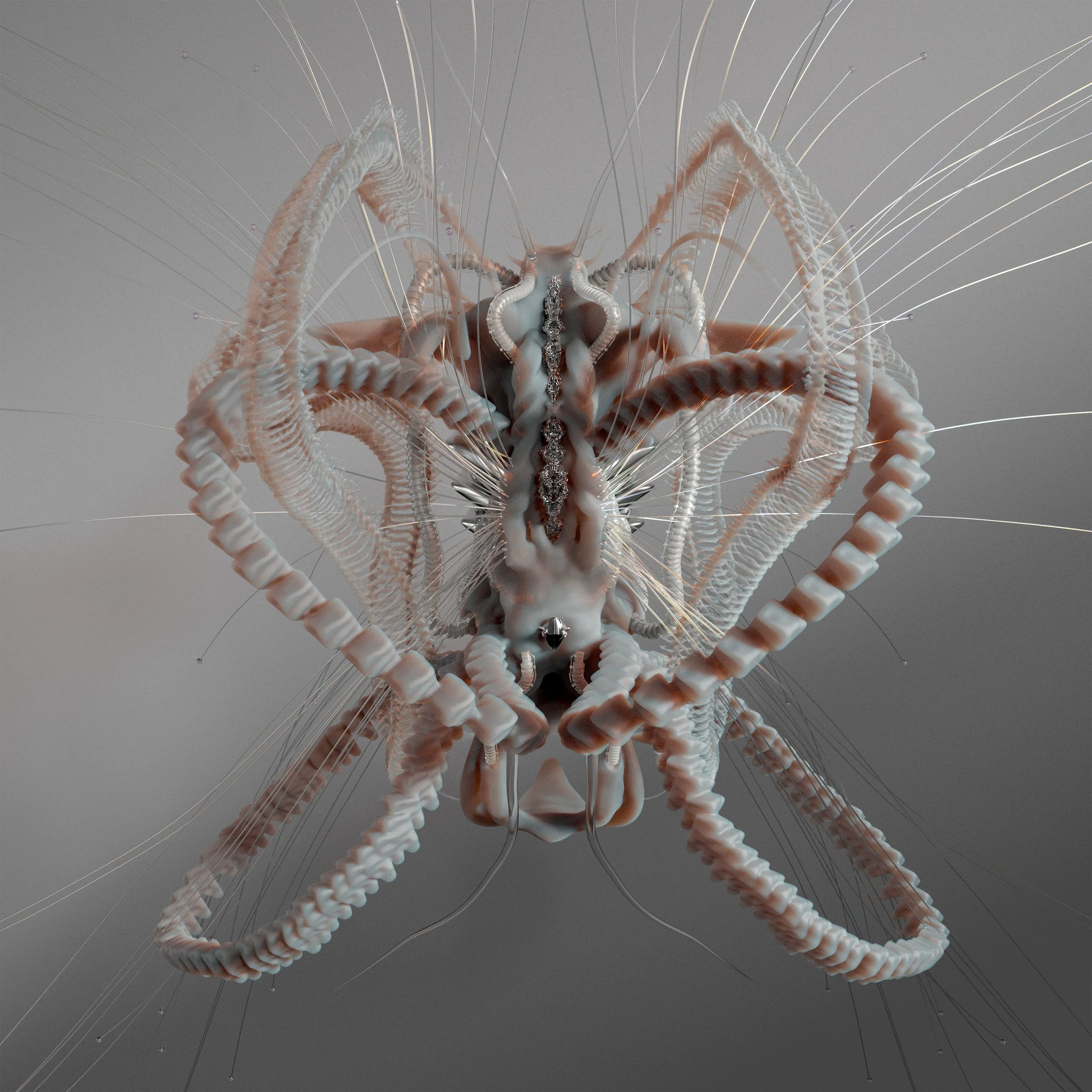
Bio Futures, 2023
Technology often promises clarity, yet your work embraces ambiguity. Why do you think uncertainty is so creatively fertile?
Clarity and uncertainty aren't really opposites to me. Technology can give us extraordinary precision, but precision doesn't necessarily eliminate uncertainty. In fact, the more precisely we observe complex living systems, the more we realize how much remains unresolved.
That's the space I'm interested in. The ambiguity in my work comes from the complexity of the conditions I am exploring rather than from a desire to obscure meaning. It's because the conditions I'm exploring don't offer simple conclusions. Adaptation, contamination or transformations are ongoing processes, not fixed states.
I think uncertainty is creatively fertile because it resists premature certainty. I think the moment we feel we've completely understood something, we often stop looking at it. Uncertainty keeps perception active. It invites curiosity rather than confirmation, and I think curiosity is a much more generative place from which to experience art.
My hope is that the viewer leaves with better questions rather than definitive answers. For me, that's often where perception begins to shift.
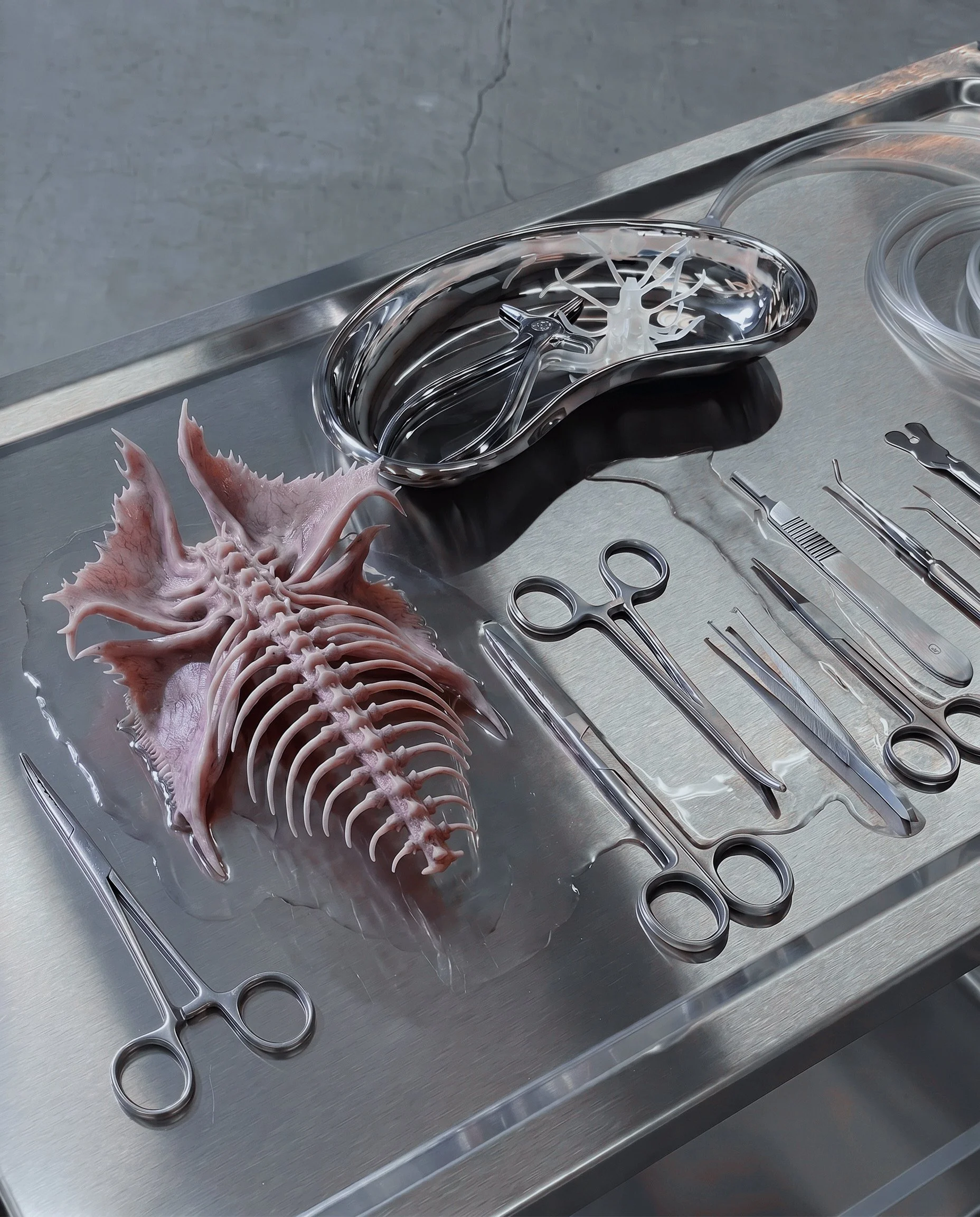
Dionae Vertebralis - Extraction 2026
Your bodies often appear unfinished, mutating or dissolving. Do you think identity is something we build, or something we’re constantly shedding?
Identity to me feels like something that accumulates under pressure rather than something consciously constructed or left behind. When I look at living systems, including people, I see forms that continuously reorganize themselves around the conditions they encounter. Previous versions don't disappear. They become embedded in what comes next, still present even when they are no longer visible on the surface.
Nobody is ever the same over time. That's simply what living does. The question is whether we perceive that transformation while it is happening, or whether we only recognize it later, when we look back. Most of the time, the change happens quietly, incrementally, below the threshold of awareness.
That is what I am trying to make visible in these bodies and organisms. The mutations, the unresolved surfaces, the forms that appear caught in transition are traces of experience. The body has moved through certain conditions, and those conditions have become part of its anatomy. The earlier form remains present, but it has been reorganized by what it has absorbed.
The idea of shedding suggests a clean separation from what came before, while building suggests moving toward a final state. Neither fully describes how I understand identity. What interests me is this continuous process of transformation, where nothing is completely erased and nothing ever reaches a final form. The body continues forward carrying everything it has encountered within itself.
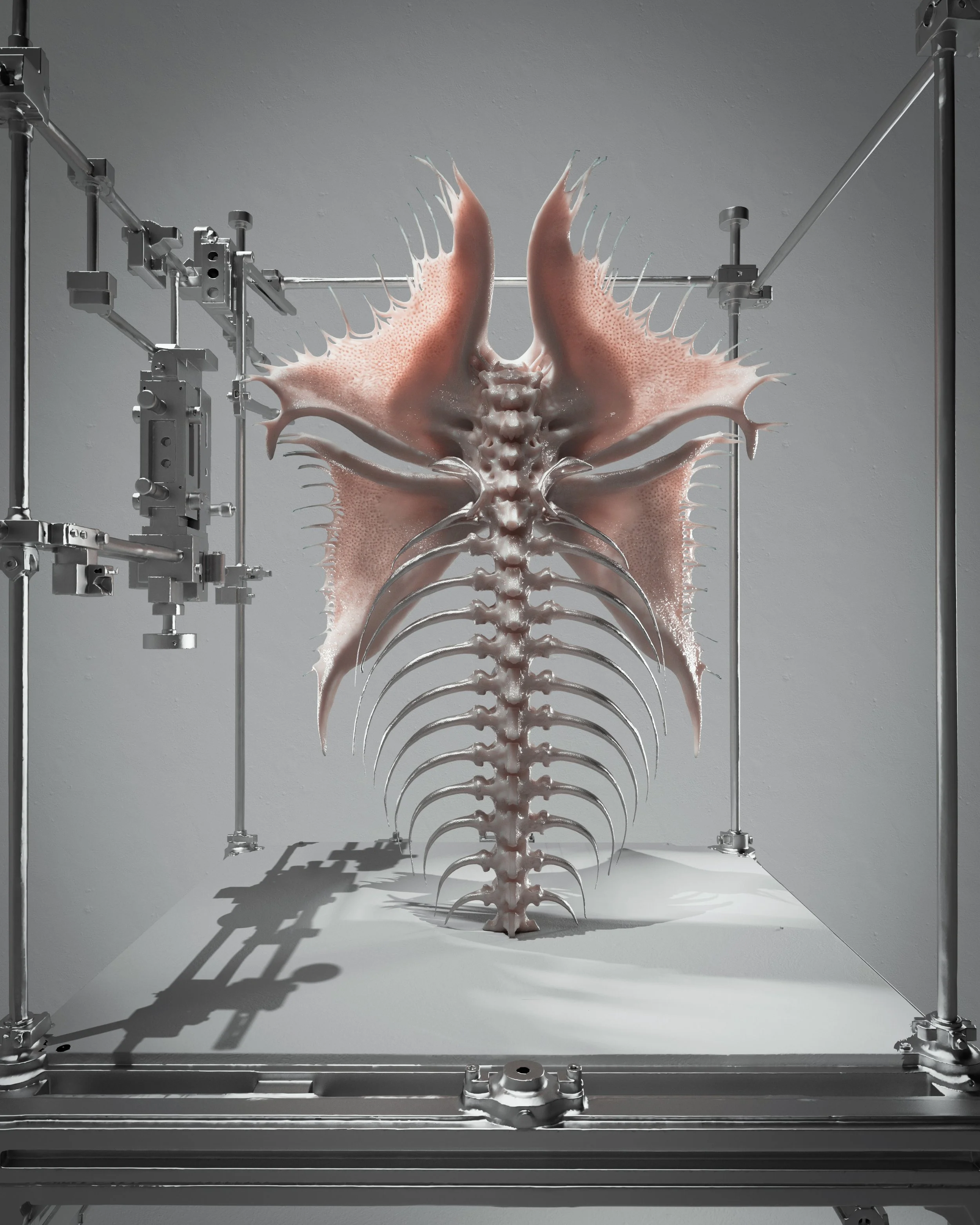
Dionaea vertebralis
What do you think when does a body stop feeling human? Is it anatomy, emotion, memory or something impossible to define?
I find it difficult to locate that threshold. Looking at my own work, even when the surface has been completely reorganized , when industrial materials have been absorbed into the skin, when metal reads as something the body grew rather than something attached to it — the ribcage is still there underneath. That skeletal memory survives everything layered over it.
So to me, a body does not stop feeling human simply because its appearance changes. There may be a point where recognition shifts into something categorically different, but I am more interested in the space before that happens. These forms have been through extreme conditions, absorbed materials that traditionally would have been considered external to a living system , and yet something continues to pull us back toward recognition.
That is what I find most interesting. The human is surprisingly persistent. It does not disappear easily, even when the body has been radically transformed by everything it has encountered.
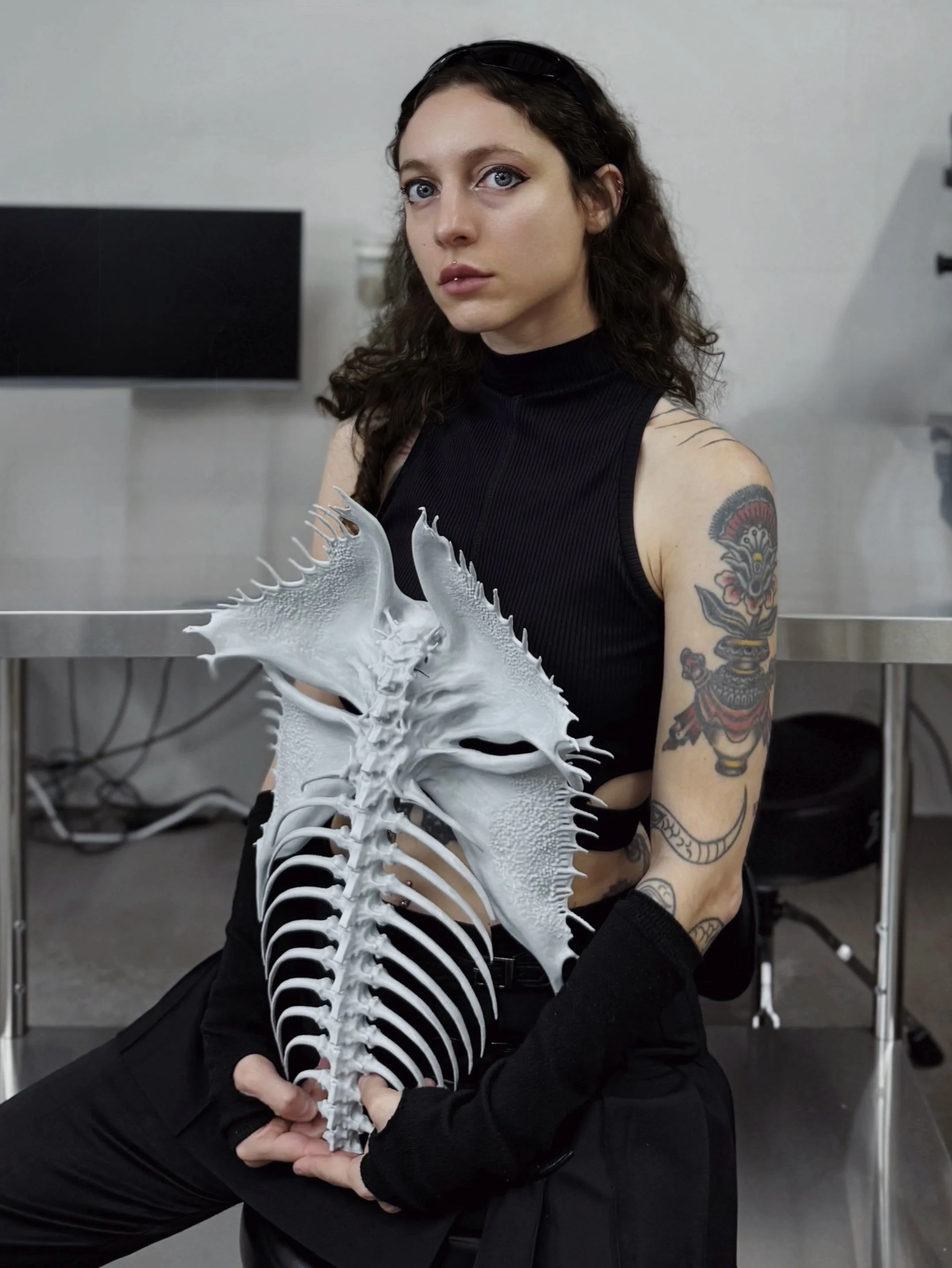
Giusy Amoroso, Studio 2026
Scientists increasingly describe fungi, coral reefs and forests as networks rather than individual organisms. Has biology changed the way you think about creativity itself?
Biology has influenced how I think about creativity, especially through the idea that living systems are never isolated. They develop through relationships, pressures, and exchanges with their environment.
My research is grounded in exactly this. Examples like Ideonella sakaiensis, a bacterium capable of breaking down PET plastic, fascinate me because they show that life does not simply respond to conditions but it can reorganize around them.
I think creative processes work the same way. An artwork develops through a network of influences, materials, technologies, memories, and unexpected discoveries. The original intention is only one part of the system. As the work evolves it begins to generate its own logic, and sometimes leads somewhere I didn't anticipate. I don't see that as losing control. I see it as the work becoming itself through the conditions it moves through.
Mutation for me is a creative principle for exactly this reason. Transformation it's how something becomes what it actually is.
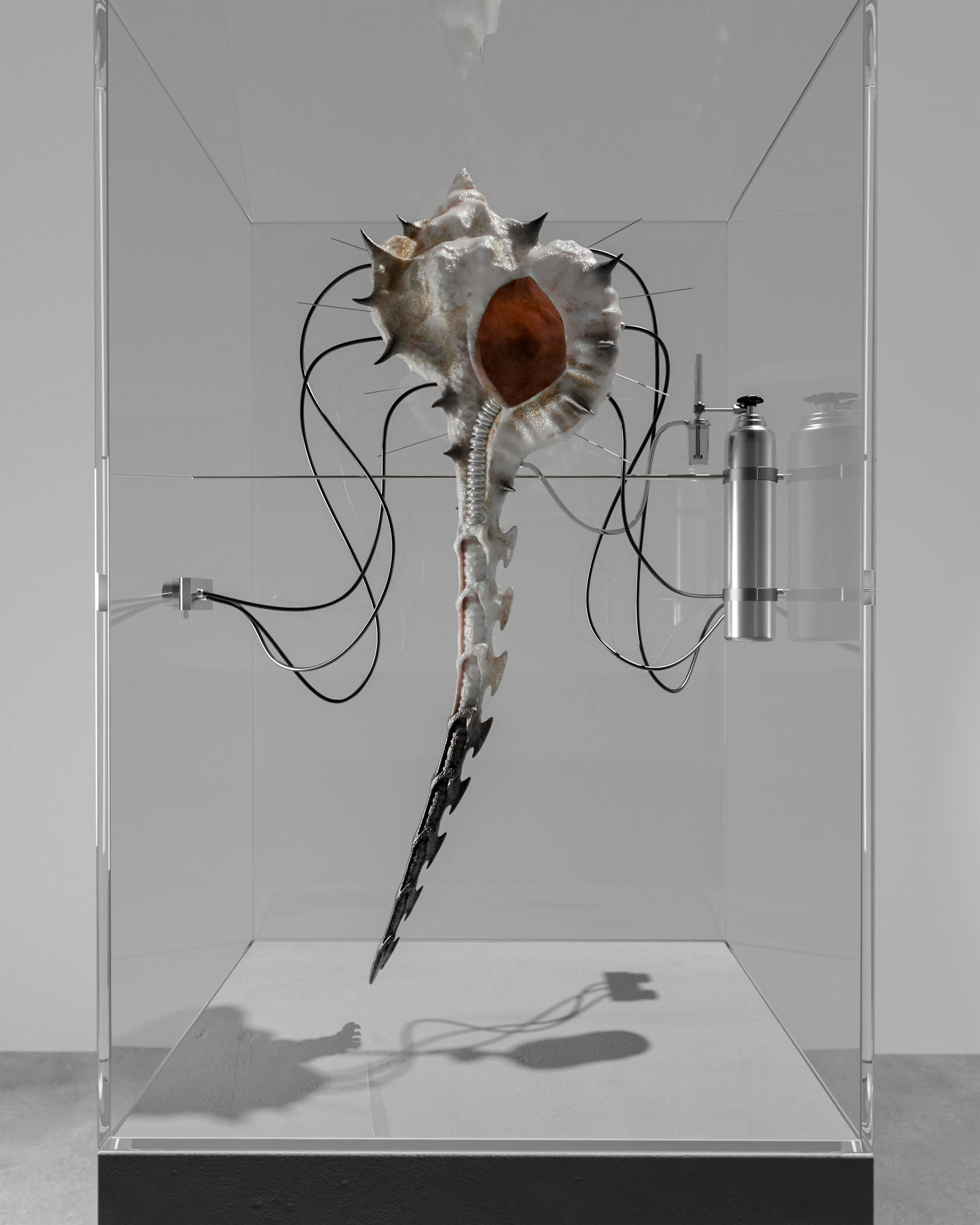
Prosthetic Seashell, 2025
Berlin has long been a city for experimentation. Has living there made your work stranger, or simply given you permission to embrace what was already there?
What was already there. That's the honest answer.
The questions I work with didn't come from this city. They were already forming before I arrived, rooted in things I grew up with that I didn't yet have the language for. Berlin didn't give me new obsessions. It gave me a context where the ones I already had didn't need defending.
Growing up in Italy, you carry a very specific cultural weight. A long history is always present as a reference point, whether you want it or not. Berlin has a different relationship with its past. Its identity has been shaped by rupture, reconstruction, and reinvention, and I think that creates a particular openness toward things that are still unresolved.
So Berlin didn't make the work stranger. It made strangeness feel like a legitimate starting point rather than something you had to justify or arrive at. It gave me permission to explore instincts that were already there.
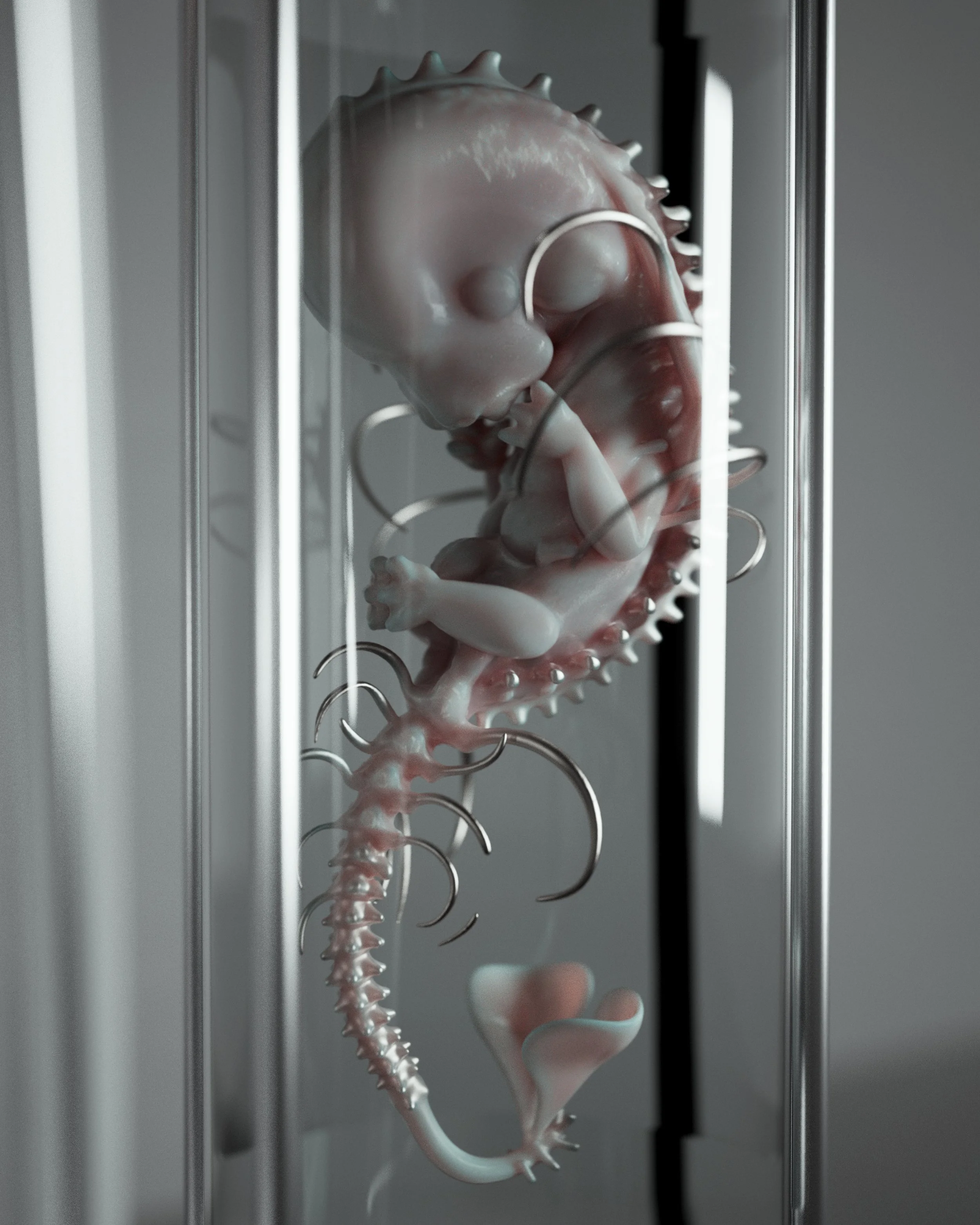
Apparatus ID - ME-01, 2026
Do your creatures ever surprise you during the creative process, or do they exist fully before?
They definitely surprise me all the time! I usually begin with a clear idea / concept of the organism I want to explore, but the final form is always shaped by the process of making.
What I find especially interesting in my practice is moving between digital and material realities. A creature that exists first as a digital model follows one set of possibilities, but when it enters the physical world everything changes. Fabrication constraints introduce new conditions that transform the original idea.
It almost feels like bringing an organism into a different environment and watching how it responds. The physical version is never a simple translation of the digital one. It develops its own character and sometimes reveals aspects of the creature I couldn't have anticipated beforehand.
That's where the work starts to feel less like something I designed and more like something that has evolved on its own terms.
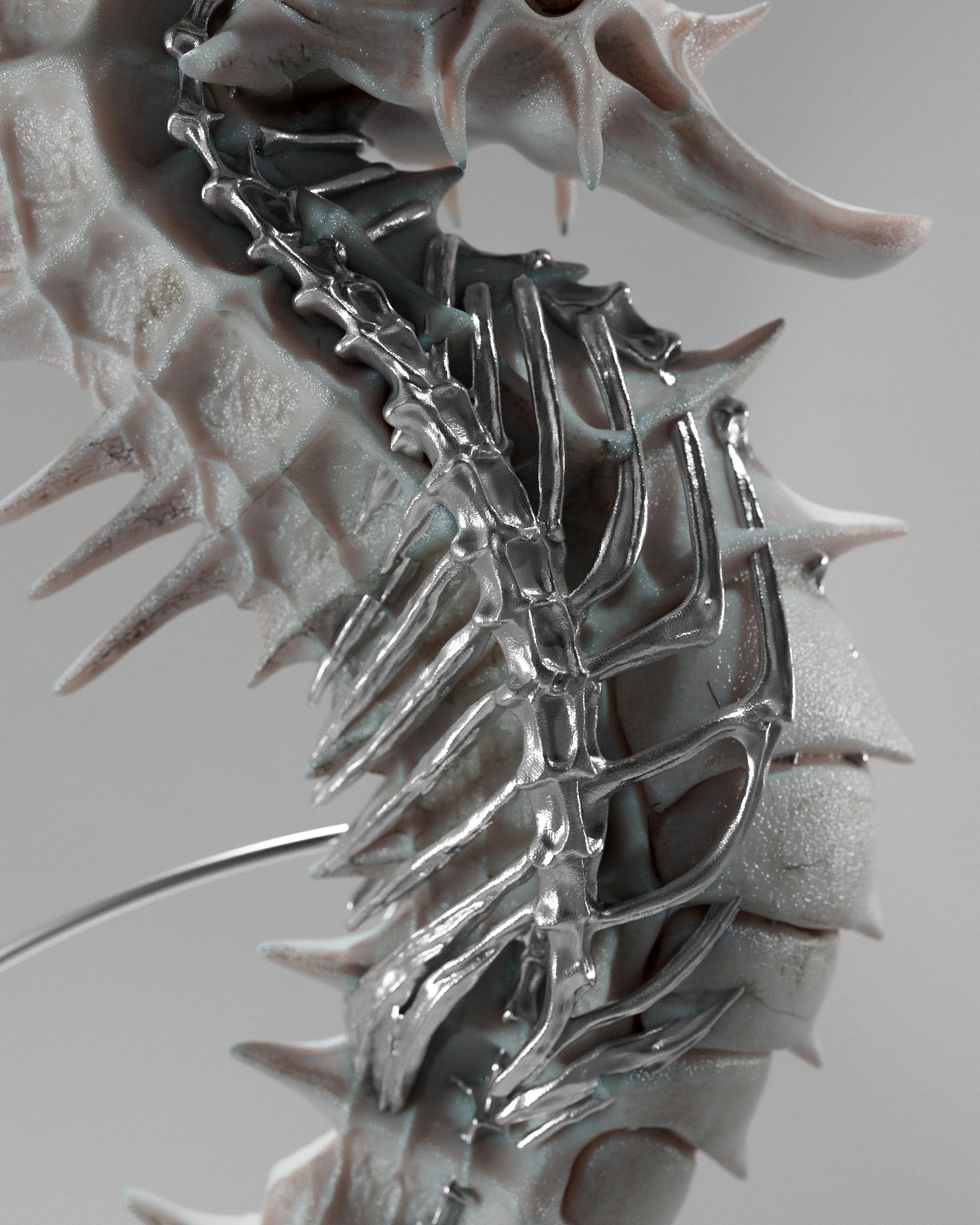
Seahorse, 2026
Do you think beauty is discovered, or invented?
Discovered, but perceived and filtered through who you are.
I think beauty exists in almost anything, but what you're able to see of it depends entirely on your own experience, your history, what you've been taught to accept or reject. Two people can stand in front of the same form and have completely different encounters with it. In that sense it's never purely objective — it passes through you before it becomes anything.
At the same time, I think the range of what people are able to perceive as beautiful is much narrower than it could be, because culture and media spend a lot of energy keeping the definition fixed. Those aren't natural responses — they're learned ones. And what I find interesting is the discomfort that surfaces when something falls outside those parameters. That reaction isn't really about the form itself. It's about the distance between what someone has been conditioned to accept and what they're actually standing in front of.
For me beauty is something you discover when you're willing to stay with a form long enough that those trained responses stop running the experience. That takes longer for some forms than others. But the pull is usually there if you're patient enough to wait for it.
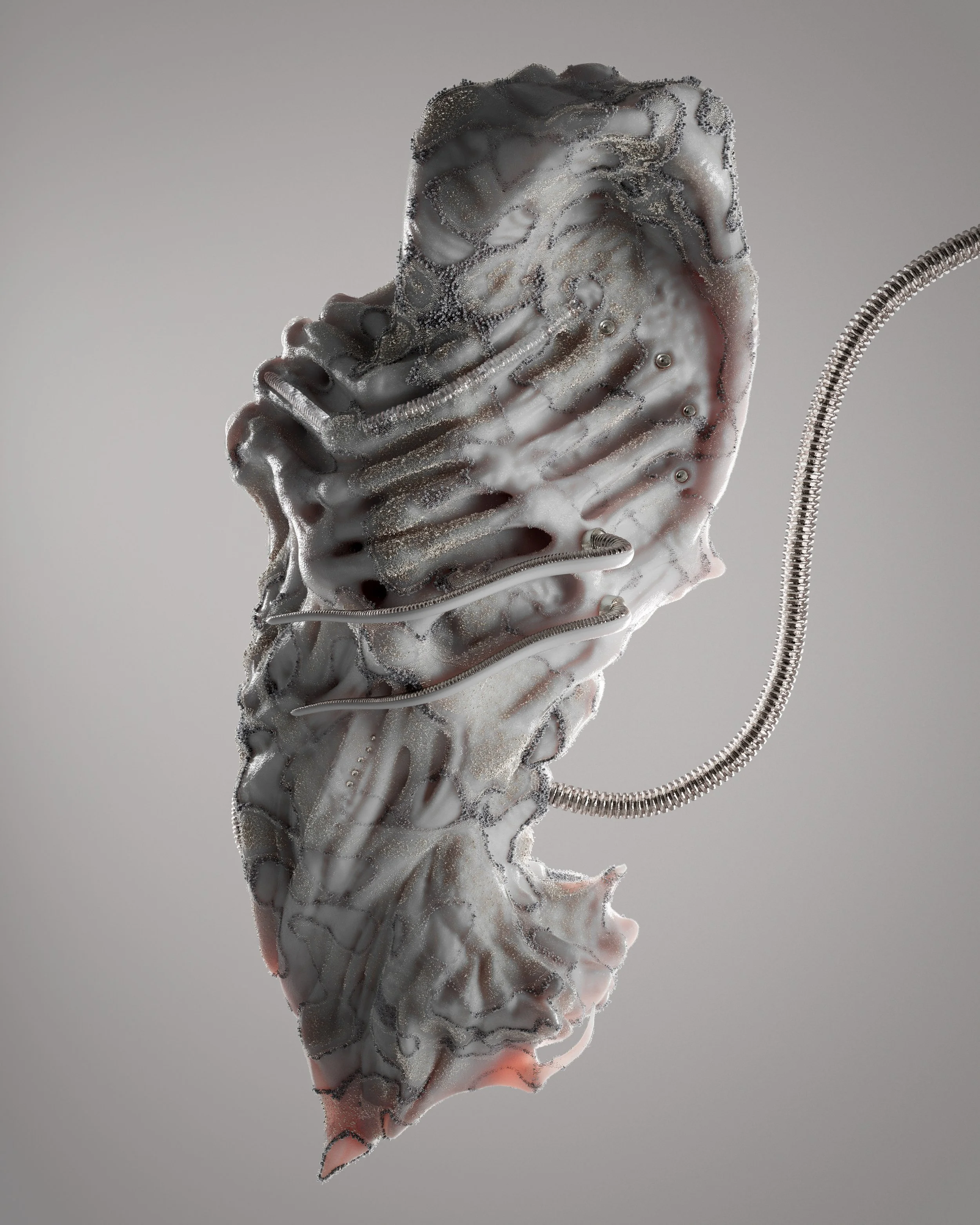
Torso
Your work suggests that transformation is inevitable rather than frightening. Is change something you’ve always been comfortable with personally?
Some changes are inevitable, but I have always been interested in how to consciously respond to them. That's probably the distinction I'd make. I don't think of myself as someone who is simply comfortable with change in a general sense — I think I'm someone who pays close attention to when something has run its course and needs to move.
There's a difference between change that happens to you and change you decide to move toward, even when the conditions that made it necessary weren't chosen. I've made decisions that looked impulsive from the outside — moving countries, shifting mediums, starting new phases of work before previous ones were fully resolved. But none of those felt random from the inside. They felt like the next logical step once something had made itself clear.
I think that's also why instability doesn't frighten me. It's not that I'm indifferent to it. It's that I've learned to read it as information rather than threat. When something starts feeling too settled, too resolved, that's usually the signal that it's time to introduce new pressure.
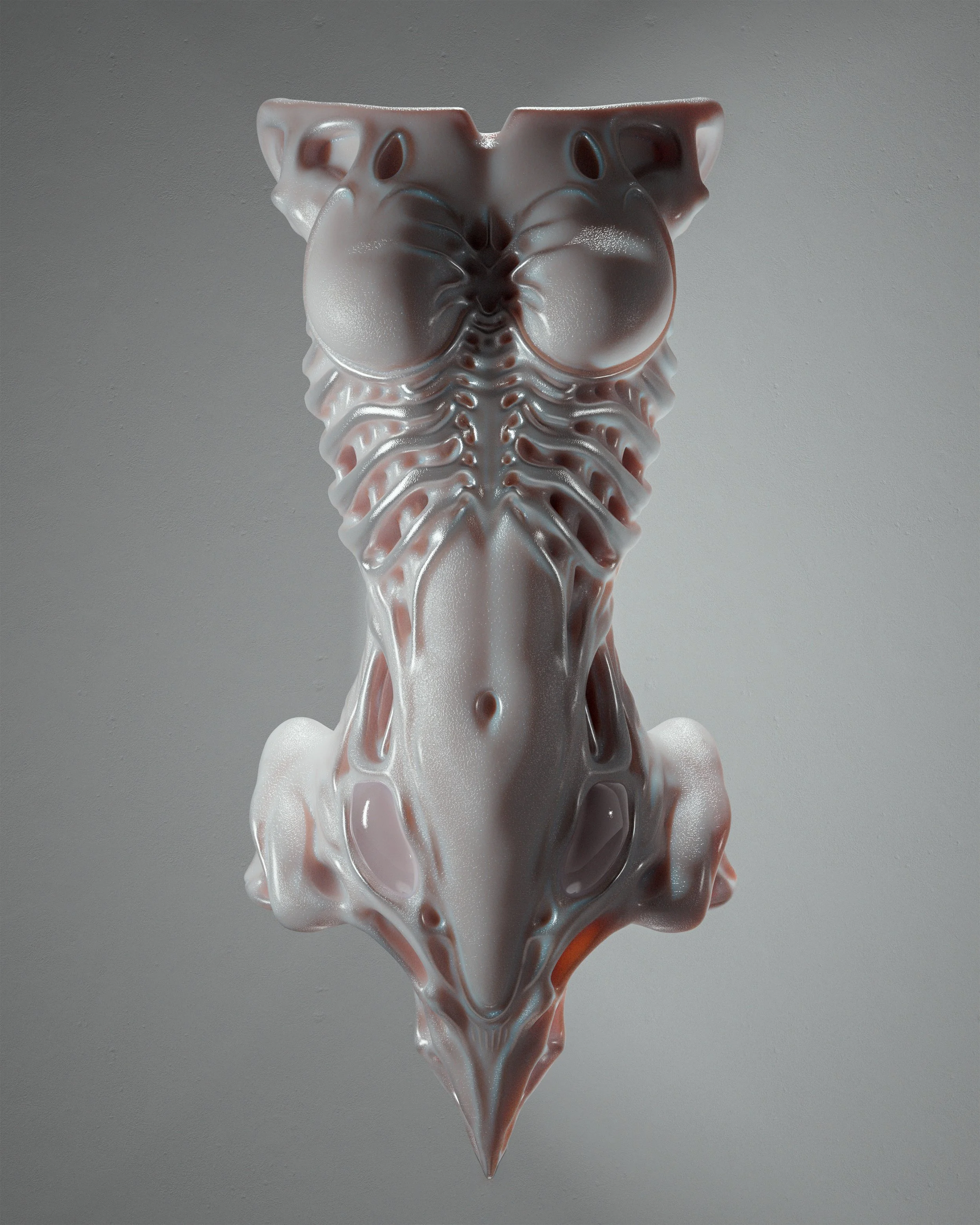
Cam01 graded
What’s a question about your work that nobody has asked you yet, but you’ve always wished someone would?
“Is there a concept from biology that has fundamentally changed how you think about what an organism actually is? “
One concept that shifted the way I think about organisms is the idea of the holobiont: the understanding that a living being is not a completely isolated individual, but a system that exists through relationships with other forms of life.
What I find fascinating about this concept is that it challenges the idea of a sealed edge around the body. An organism is not a fixed, independent structure; it is constantly shaped through exchange, interaction, and dependence. The idea of a self-contained body becomes much more complicated.
This way of thinking influenced how I approach the bodies I create. I am interested in what happens when the line between organism and environment becomes unstable, when what was considered external starts becoming part of the internal structure of a body.
The holobiont concept made me look at life less as something defined by separation and more as a continuous process of negotiation between different systems. For me, that raises a larger question: if organisms have always been shaped by what they incorporate, where do we actually draw the edge of a body?